Counting Collections
A guest post by Cherise Jones + a printable one-pager

Cherise Jones is a teacher on special assignment (TOSA) in Southern California. We are so grateful that she’s sharing a bit about her Counting Collections practice with us here.
An introduction to Counting Collections:
Counting Collections in the early education setting brings a world of mathematical possibility to the classroom that allows the young people to discover and strengthen their understanding of the mathematical world and gives the adults a glimpse into how the young person is thinking about numbers, quantity, cardinality, and organization and how they persevere, problem solve, engage creatively and express their ideas.
Key Ideas:
Classroom activities should build up the ideas that our students have about numbers and quantities in the world instead of supplanting their ideas with formalized math ideas.
The teacher sets up counting collections and has the collections ready, but the students are directing their engagement and attention with the collection.
Counting Collections can look deceptively simple and feel overwhelmingly complex simultaneously.
To launch a CC task with a group of students, you’ll need:
blank paper for students to write on
something for students to write with
and some collections.
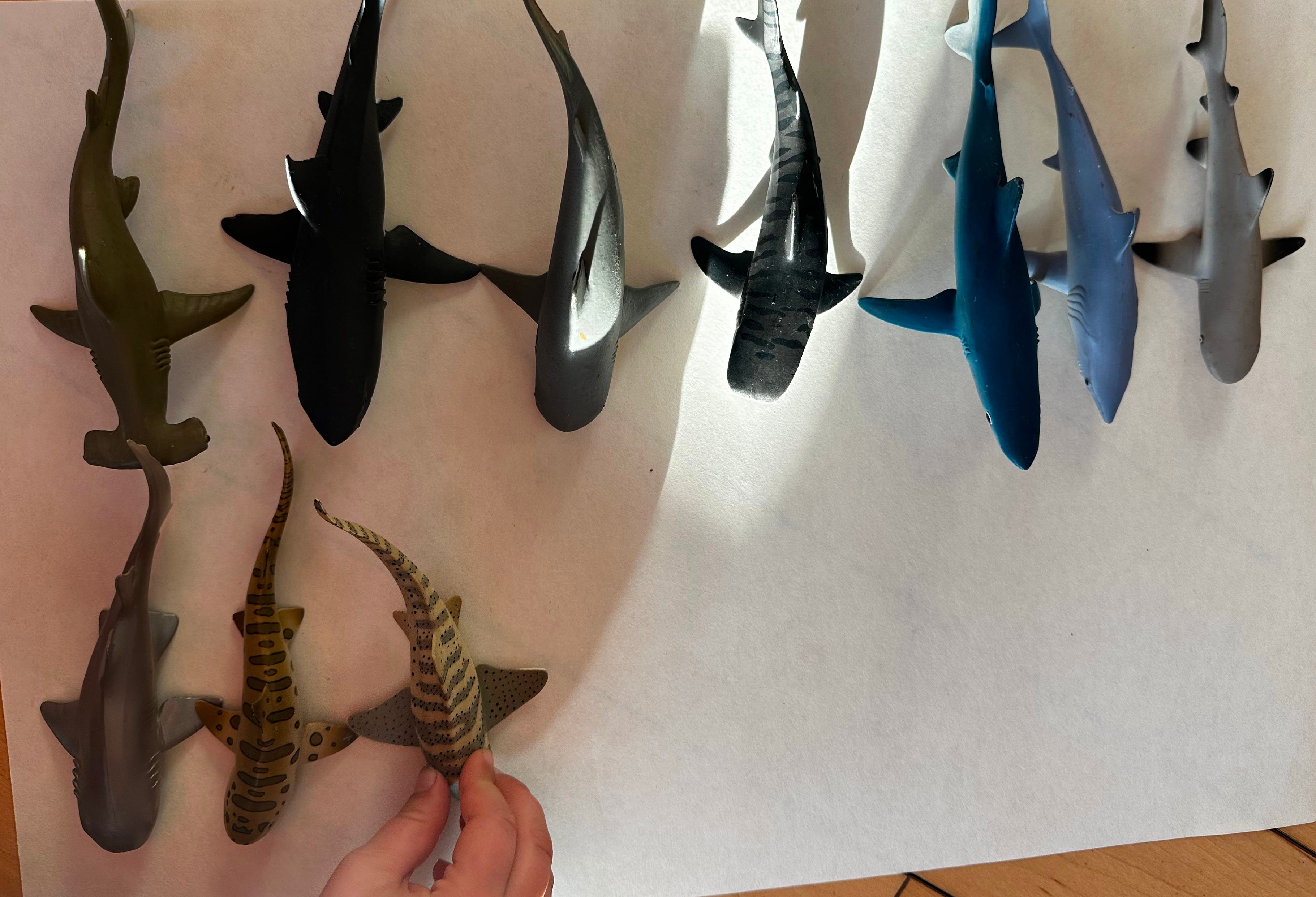
Collections in TK commonly range from 10-40 items per container or baggie. Collections can be any age appropriate item that is easily accessible, including: the blocks in the building area, a tub of Legos, paperclips, foam shapes, unifix cubes, crayons, small plastic animals, assorted puzzle pieces that don’t belong to a puzzle in the classroom, unused sporks or straws. The options are endless!
Then, we prompt with, “Let’s find out how many items are in our collections today!”
How could the logistics work?
Some classrooms benefit greatly from having all students participate in counting collections at the same time. Since all other work centers are closed and all students are working on counting their collection, some teachers find that the collective momentum keeps students focused and productive with their collections for longer. However, some teachers will find higher levels of engagement and focus when only one small group of students is counting collections at a time. Just remember, the students are to be directing their interaction with the collection even when seated at the “teacher table.”
As students get started with their collections, the adults in the room observe students as they dive in, listen attentively, capture anecdotal notes, videos and pictures as students work. We should approach CC through the lens of guided play. The teacher is setting up play and the students will be directing the play. Approach a child’s collection with curiosity and wonder as you seek to understand the mathematical ideas that surface as the student selects their own collection, counts their collection, represents their collection on paper and tells a peer or teacher all about their collection. Expect that each young person will find a unique entry point into the activity and will follow their own curiosities as they touch, move, organize and play with their objects. It is common and expected that early ed support providers will need to re-invite students to find out how many items are in their collection. Be prepared to embrace students’ unique perspectives and resist the urge to push students towards compliance, completeness or correctness.
Here are three examples of three students engaging meaningfully and productively with Counting Collections:
A student has a collection of 18 butterflies in 6 different colors. She organizes them by color and lines them up in this way: 3 yellow butterflies, 3 orange butterflies, 3 blue butterflies and so on. When asked how many butterflies she has in her collection, she reports, “3 yellow, 3 orange, 3 blue …” The student does not take up the invitation to represent her collection on paper and begins to interact with the other students and collections at the table.
A student has a collection of 26 dinosaurs. He explores each one as he carefully stands the dinosaurs up on their feet. When about half the dinosaurs are on their feet, the teacher re-invites the student to find out how many dinosaurs he has and he says, “One, two, tee, five.” The teacher checks for cardinality, “How many dinosaurs?” and he replies “Five!” The student continues to stand up more dinosaurs. He is then invited to represent or show his dinosaurs on paper. He selects a blue marker, makes a circle on the paper and places one dinosaur on the circle. He then draws a vertical line and moves a dinosaur from the table to the paper. He continues until all 26 dinosaurs are standing on either a circle or a vertical line on his paper.
A student has 54 gold coins. She counts them in Spanish as she moves them one by one from the table to the teacher’s hands. She counts to 49 in Spanish but skips the numbers 7, 17, 27, 37 and 47 in the counting sequence. The teacher checks for cardinality, “¿Cuántas monedas tienes?” She removes the coins from the teacher’s hands and begins to count again. When she is invited to show her collection on paper, she looks around the table for meaning and sees another child tracing the objects onto the paper. The student selects a pink marker and begins to trace all 54 coins onto the paper and flips the paper over when she runs out of space.
Early education students often sustain attention with Counting Collections for about 10-20 minutes before the teacher creates the space for students to engage with the collections of others. This can take as few as 2 minutes and can be integrated before or after students return their collections to the bag or container.
Students and teachers form a human train that walks through the classroom noticing the collections of others, possibly stopping to notice something interesting. (gallery walk)
Show a picture of a student’s collector, recording page or both. Ask the class what they notice and what they wonder. The student who counted the collection can confirm and respond to the noticings and wonderings. (notice and wonder)
A student shares their collection with the class. The teacher can bring the class to where the student’s collection is located, bring the collection to the center of the rug or display the collection on the board. The student tells the class all about their collection, often with prompts from the teacher. To keep the class involved, it is best to find an opportunity for the whole class to participate in the share. An example could be to ask the class to count aloud the items in the student’s collection as they point to the items or move the items. (open strategy share)
Students are paired and travel together to visit the collection of one partner and then travel together to the other collection. You can guide these interactions initially by giving prompts like 1) tell your partner what you counted, 2) count the collection again together or 1) tell your partner what you counted, 2) tell your partner how you made your representation. (pair and share)
When teachers can maintain the mindset that we are setting up guided play through counting collections and allow our students to direct their engagement with the collections, we will create a space where students build confidence and ownership in their mathematical ideas and are willing to observe the interesting ways that their classmates engaged with their collections.
Deepening of CC
So you’ve collected items into baggies for students to count, engaged your students in counting collections, and you’ve been soaking up all of the very interesting ways they organize, count, and record their collections. As you watch your students with their collections you may have had one of the following questions, “What should I do when I see a student make a mistake?” or “Should I be differentiating the size of the collection for students who are just learning the number sequence?” Let’s explore these questions!
Misconceptions that arise as you watch students count their collections can be captured or recorded to inform future inquiry for the class. As an example, if you see student skipping numbers as they count or declaring that there are 100 items in their collection of less than 20 (because there are a lot of items), we might pose one of the following questions to the whole class or a small group of students later in the week:
How do we know the number of items in our collections after we count?
What are the ways we can figure out the next counting number?
You can embed these questions into a scenario and ask students to help you figure this out. “I was counting my collection just like this ‘1, 2, 3, 4, 5, 6…’ and then I stopped. Can you show me how to remember what number comes next so that I can keep counting?” By accepting a variety of student responses, you scaffold students to use the tools and resources around them. You may conclude by saying, “When you are counting your collections today, you can also use (list the tools or ways that students suggested) to figure out your next counting number.”
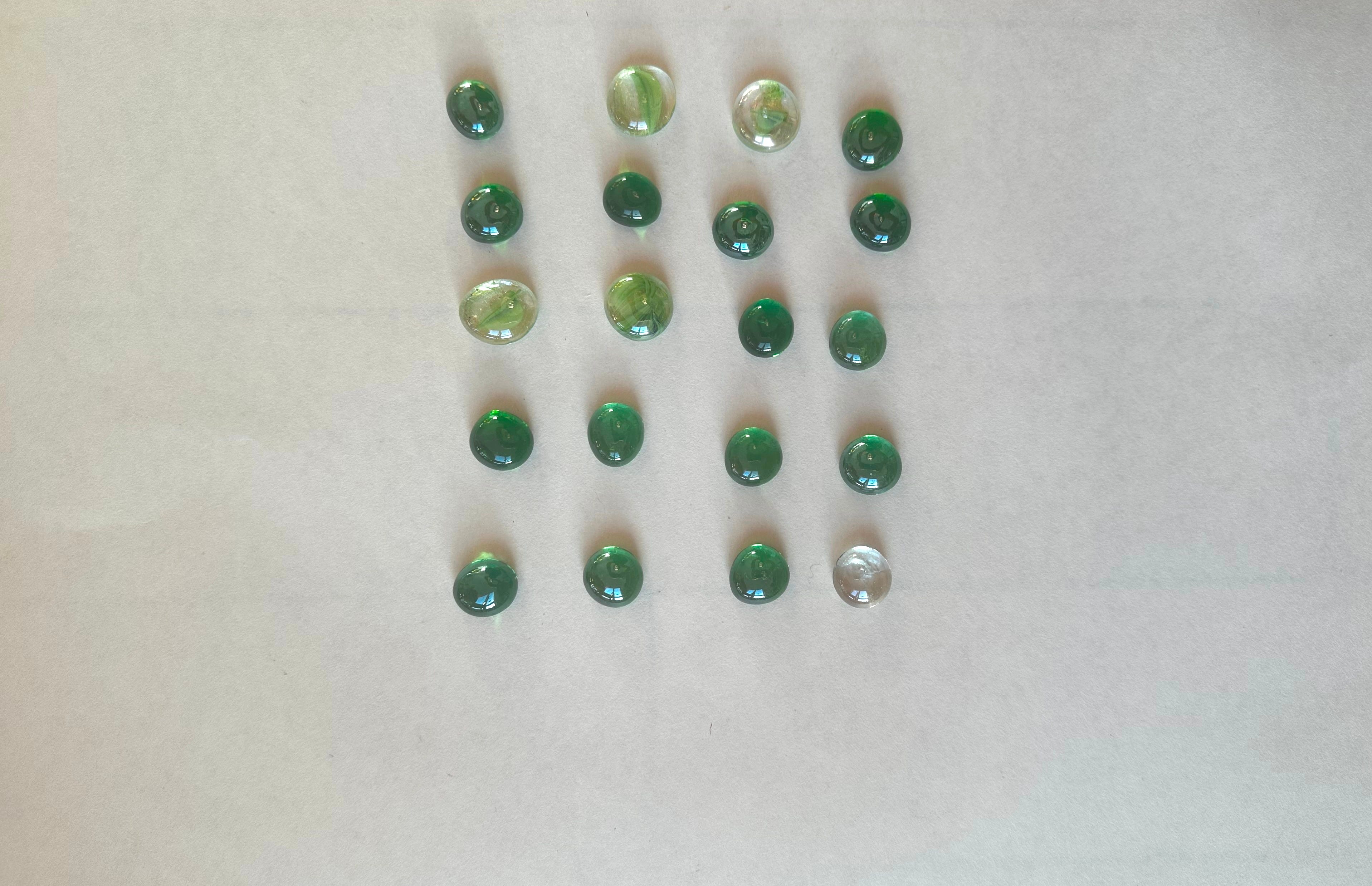
There can be a tendency to want to match the size of the collection with how high a student can count. This can take all of the thinking and creativity out of the activity for students and frames Counting Collections with a focus on compliance, completeness and correctness. Remember, counting collections is set-up by teachers but directed by the student. We want to know: what will students do when their collection exceeds their counting sequence, in what unique ways will students organize, sort or engage with their collection, how do students watch and learn from others? When you know that a student is working with a collection that exceeds their counting sequence, you may consider approaching them by first asking them to tell you all about your collection. Then, ask a follow-up question about a specific detail of their collection like, “What did you do after you put the blue ones together?” or “Tell me about this group (pointing).” Finally, invite them to count a subset of their collection. Focusing on counting a subset can allow students to engage with a larger collection in meaningful ways while removing any pressure to know more than they currently do. It is important to note that you should always ask your follow up questions in ways that are congruent with what they student has already done or said about their collection. This validates the work and thinking that they have done while stretching them to count. Here are some examples:
The student has a collection of over 20 butterflies that she has sorted by color. After asking her to tell me about her collection, I say ““I wonder how many blue butterflies are in your collection?” The student now counts the 4 blue butterflies and replies 4.
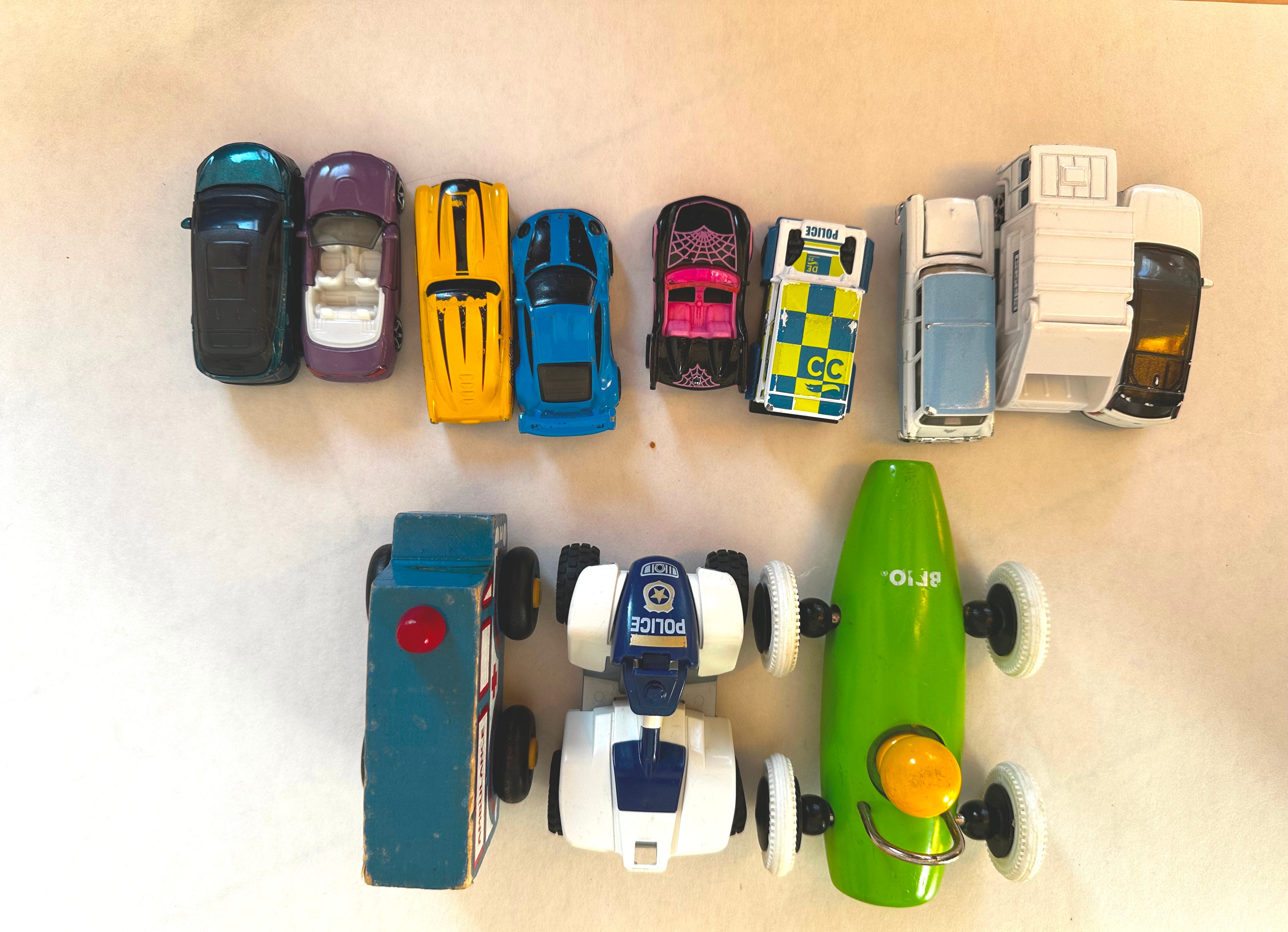
A student has a collection of vehicles. He tells you that he has “these ones” on the floor because they are in the construction site. The rest of the vehicles are on the table. I ask, “How many vehicles are in the construction site right now?” Without counting, the student picks up both vehicles, one in each hand, and declares “Two!”
A student has a collection of square tiles. He is picking up a tile at a time from a pile, tracing it on paper and then moving the tile a cup. After asking the student to tell me about his collection, I ask, “How many tiles have you already traced?” He empties the cup and places the tiles on the traced shapes on the paper and says, “This many!” I reply, “Wow! Those are all the tiles you’ve already traced. Do you want to count them together?” While we point together at the objects, we count to 7. He then puts the 7 back in the cup and continues to trace.
As more questions arise, you can guide your response by reflecting on whether your response will allow the student to build up their inherent mathematical ideas without supplanting them with formalized math ideas and whether your response allows the student to keep their role as their director of their engagement in the collection.
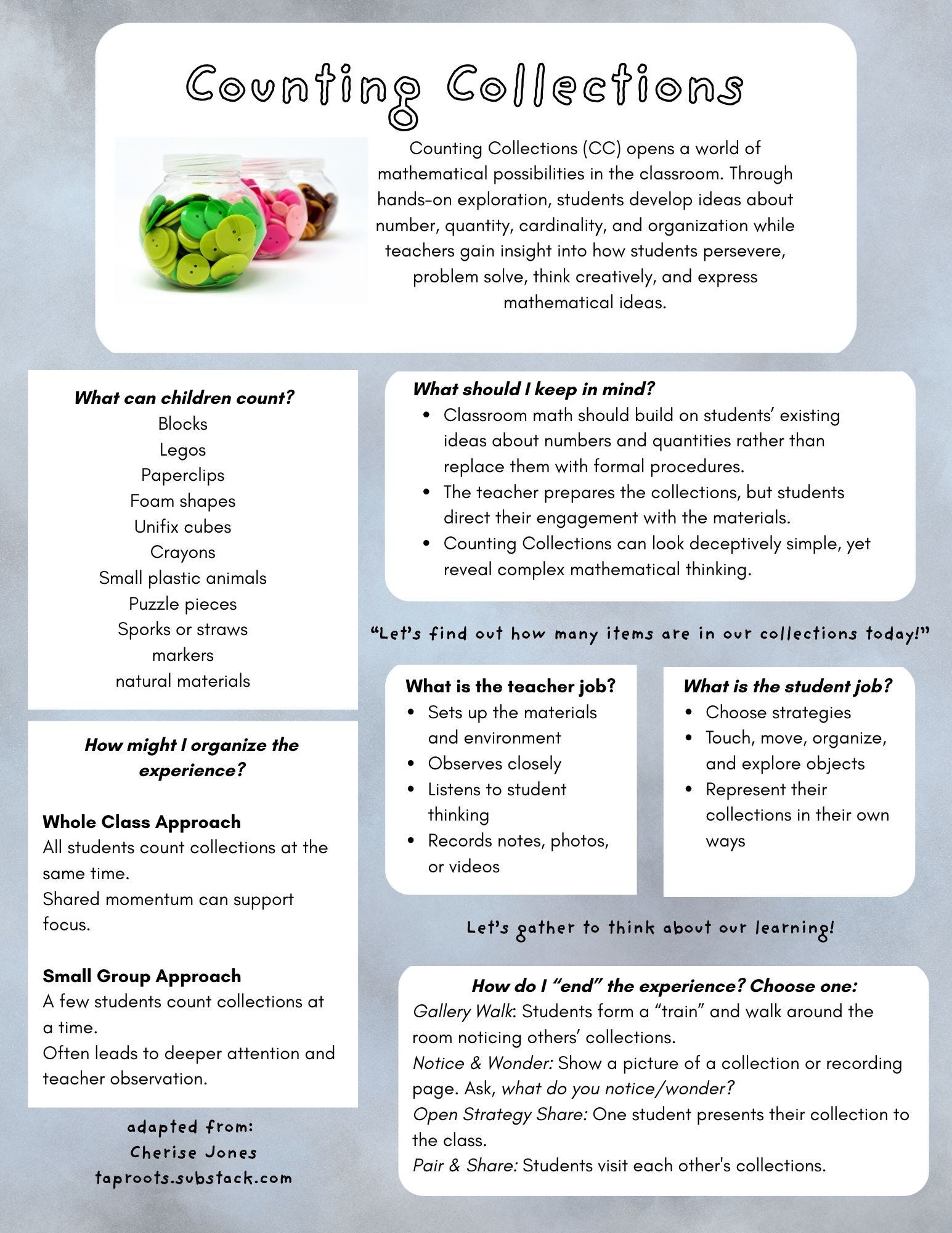
Thank you Cherise! Here’s a printable one-pager we made from Cherise’s post: