

Expert Post from Dr. Julia Lindsey: For the Joy of Words
Top Questions about Phonics, Research, and Motivation
We are delighted to share the voice of another expert with our readers today. Dr. Lindsey is a reading researcher, consultant, and former teacher. Navigating the conversation about reading research can be challenging for teachers. It can often be hard to figure out what exactly you are reading: a curriculum company’s interpretation, a presenter’s preference, a lab controlled research finding, or just someone’s random idea on TPT.
Enter Julia! We appreciate that Julia trusts teachers and their ability to make informed choices. She shares research and offers analysis and interpretation, but she does not want to sell you a magical one stop solution to all reading challenges. She wants us to think, and reflect, and learn. In short, she wants to give us tools to be informed, responsive teachers, not automatons or curriculum delivering machines. Below she shares with us some research backed answers to common reading instruction questions.
How do these take-aways interact with your views of playful, responsive instruction? What questions do they generate for you? What tensions? What are you grappling with in your own reading instruction? How can we use this information to find more time and space for children’s interests and curiosity?
Our next post will feature how much of this looks in a Kindergarten classroom.
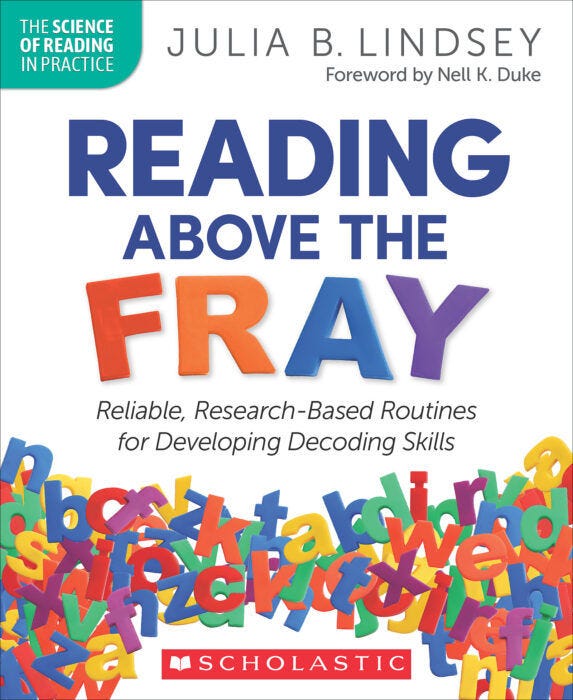
Hi friends! I’m Dr. Julia Lindsey, author of Reading Above the Fray. I’m honored to get to spend my time and expertise supporting educators across the country (and, indeed, the globe) in utilizing research to drive more efficient, effective literacy instruction. Today, I’m joining the Taproots community to answer the top 5 questions I get related to phonics, phonemic awareness, research, motivation, and (brace yourself) fidelity.
1. How does phonics relate to reading motivation?
Let’s reframe this question: can a child be a motivated reader if they are unable to recognize words? If children do not acquire decoding skills, children’s motivation to read will decline (Morgan et al., 2008). Further research demonstrates that children who have strong reading skills will become motivated readers, but children who are highly motivated will not necessarily become strong readers (e.g., Toste et al., 2020; van Bergen et al., 2022). Said another way: If you want children to become motivated readers, children must first develop strong skills.
Key step: Remind yourself and your readers how the small skills in phonics relate to reading and writing – don’t just leave these in an isolated phonics block!
2. Is explicit phonics instruction inherently anti-joy?
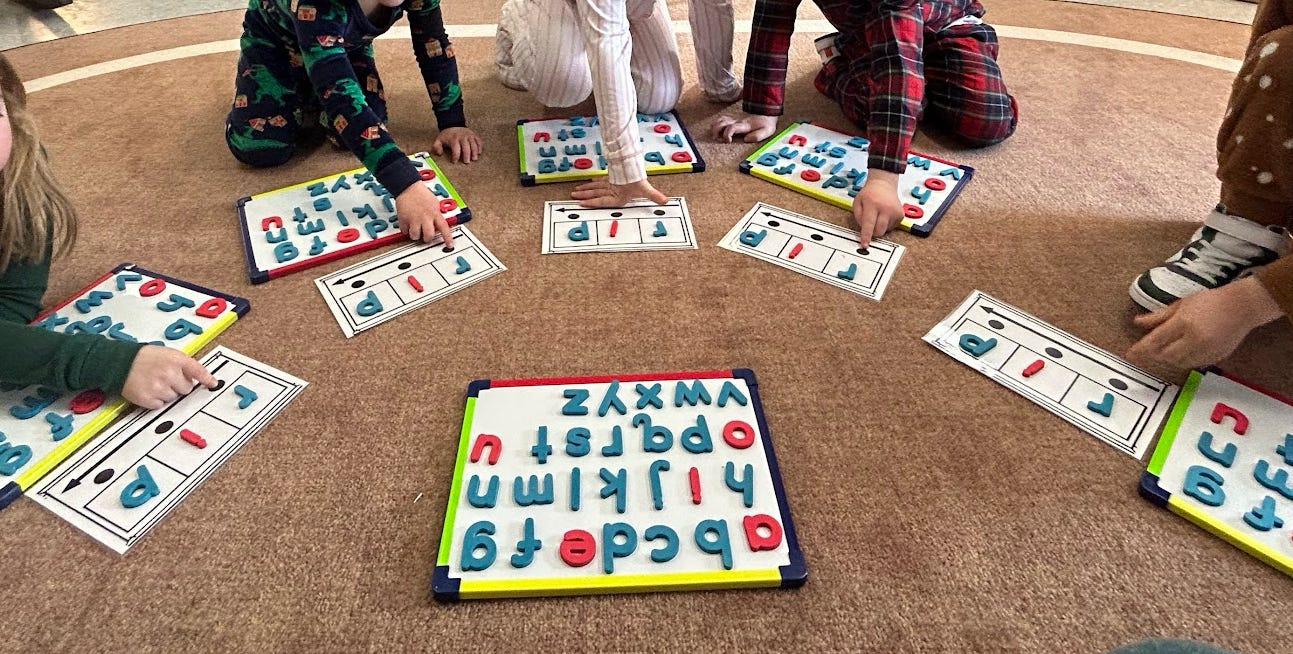
Explicit, systematic language will benefit your students (Stockard et al., 2018). The research in this area is quite clear; indeed, the argument for explicit, systematic phonics is likely one of the strongest research-based arguments in all of literacy development. Explicit phonics, thankfully, does not decrease motivation nor does it need to be joyless. In one of the most interesting studies on this topic, researchers taught children the alphabet in two conditions: through a storybook or in a very direct, explicit manner. Not only did children learn the alphabet much better in the direct instruction, they actually preferred it! Children overwhelmingly said they would prefer to do the direct instruction again and researchers recorded students were more engaged (Roberts et al., 2020).
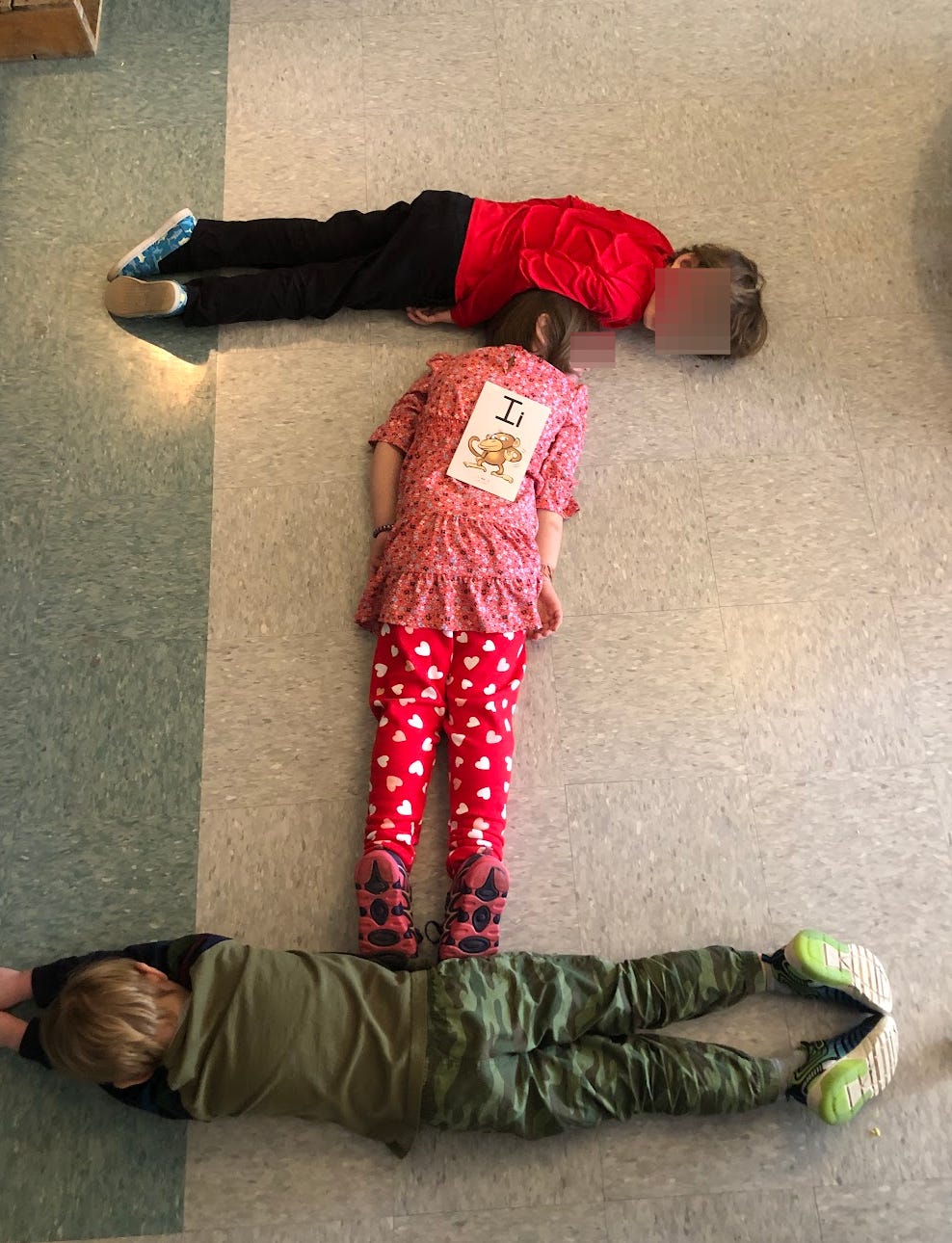
Key step: Phonics can be explicit and still include games, silliness, and laughter. Don’t forget to bring in your own joy to phonics!

3. Are decodable texts going to hurt student motivation to read?
Yes, decodable texts that are meaningless, use stilted language, or are culturally inappropriate might harm student motivation. Thankfully, not all decodable texts fall into these categories and emerging research shows some decodable texts may improve motivation! Last year, I worked on a small pilot study with ReadWorks using their free, content-rich decodable texts. We found that first grade students improved their word reading, comprehension, and motivation. Take this quote from a teacher involved in the pilot, “Finding culturally relevant decodables is so hard, if not impossible. When you do find some, it's mostly just superficial representation. The illustrator may just add a black or brown face to a character. ReadWorks' content-rich decodables are a vehicle for culturally relevant content in a way that other decodables are not. My reading group was three Black girls, and the week with the highest engagement was when we read the text set about African American women. They had so much to say and drew so many connections, which simply doesn't happen with other types of decodables.”
Key step: Grab some content-rich decodables for free from ReadWorks or my website, Beyond Decodables.
4. How much time should I dedicate to oral phonemic awareness practice?
First, what is oral phonemic awareness practice? It is when we ask children to identify, say, match, blend, segment, or manipulate sounds without letters. If children can accomplish the task with their eyes closed, it’s oral only. If children need to use manipulatives but not letters, then it’s also oral only.
With that… Hold onto your hats! A recent meta-analysis found the optimal dosage of phonemic awareness instruction is about 10.5 hours (Erbeli et al., 2024). Total. That’s about 3.5 minutes a day. What does this mean? After about 10.5 hours (for both average and at-risk readers), spending time in oral-only phonemic awareness instruction led to decreased impacts. YIKES! In other words, we don’t want to maximize time in oral-only phonemic awareness instruction, but instead want to be targeted and precise. Most of our phonemic awareness work should actually include letters, which is likely to impact students for an indefinite amount of time (Erbeli et al., 2024; Rice et al., 2022; Stalega et al., 2024).
Key step: Once children know about 10 consonant and 3 vowel sounds (Gonzalez-Frey & Ehri, 2020), be sure to include letters with phonemic awareness practice.
5. Will fidelity to my program mean all my students learn to read?
Many administrators say it is essential to use programs “with fidelity,” by which many mean they want to use a program exactly as written to ensure children learn. It is worth noting that some research (such as on the phonics program UFLI; Lane et al., 2025) does find that higher fidelity to the program leads to better outcomes. However, there are several challenges with thinking about fidelity across all programs. First, many programs have never been studied in research, so there is no guarantee that using a program with fidelity will lead to particular outcomes. Second, one synthesis of studies actually found that specific programs adopted did not matter as much as the instructional practices that teachers used when implementing the program (Slavin et al., 2009). Third, some programs include virtually no built-in opportunities to differentiate instruction based on specific skills. For example, one widely used core literacy program includes three small group reading lesson plans per week for teachers to choose from for “low, on grade level, and high” readers, designations that are likely too vague to precisely support needs. And, fourth, some programs that say they are based in research include elements that are antithetical to research: for example, many programs still have an alphabet letter-a-week structure despite overwhelming evidence against this (Sunde et al., 2020; Vadasy & Sanders, 2021). So, sadly, we really cannot say if fidelity to a program will automatically lead to all students learning to read.
Key step: Gather a group of educators and administrators to look over curricula or programs to identify the elements most supported by research and focus on implementing these portions with greater fidelity.
Have a question about reading research? Please feel free to reach out to me at julia@juliablindsey.com or follow me on instagram @JuliaBLindsey. Happy teaching!