

In and Out With (a bit more) Ease
Three strategies for supporting children through transitions, no matter the weather.

One of the biggest hurdles to getting outside with children is just that, getting outside with children. Seasons are changing and in many parts of the country this means adding layers, steps, and invariably time to the transitions. Here are three strategies from classrooms to support getting outside with a group of children, snow pants and all.
1. Use a routine to bookend the transition:
We’re just starting to learn about a strategy called Re-Set based on the work and book by Dyane Lewis Carrere. This process formalizes strategies that many of you probably do with your students to help them regulate and transition. We’ve seen teachers use this process before transitioning outside and after transitioning back inside. They’ve said it seems to help children regulate and be ready to think about what is next.
Jenny, a preK teacher, gathered her students in a circle and went through the steps.
Step 1: Move your body
This step burns off stress chemicals like cortisol and adrenaline. Even if it doesn’t seem like a particularly stressful time, doing this proactively can set children up for a smoother transition. Jenny had her students do big arm circles first one way then the other, but this could look like running in place, hopping on both feet, or doing jumping jacks.
Step 2: Modulate down
This moves students from highly active gross-motor activities to more refined gross-motor activities. Jenny had her students do ten shoulder shrugs, tightening at their ears and then releasing. Large movement activities (like arm circles) can be made smaller. Other ideas include going up and down on toes or listening for the end of a chime.
Step 3: Activate thinking
In this step, you’re “reactivating the cognitive portions of the brain.” Jenny chanted a rhyming poem, line by line, while patting her knees rhythmically, and had her students echo it back. Other suggestions include playing Simon Says (*no one loses), skip counting, or drawing shapes in the air.
Step 4: Make a plan
In the final step, children are given a direction for what to do next. In Jenny’s case, she talked about what steps would be first in the transition. Pam, a Kindergarten teacher, had children point to the center they wanted to start their choice time out. The plan can be simple, but it’s starting from a point of regulation.
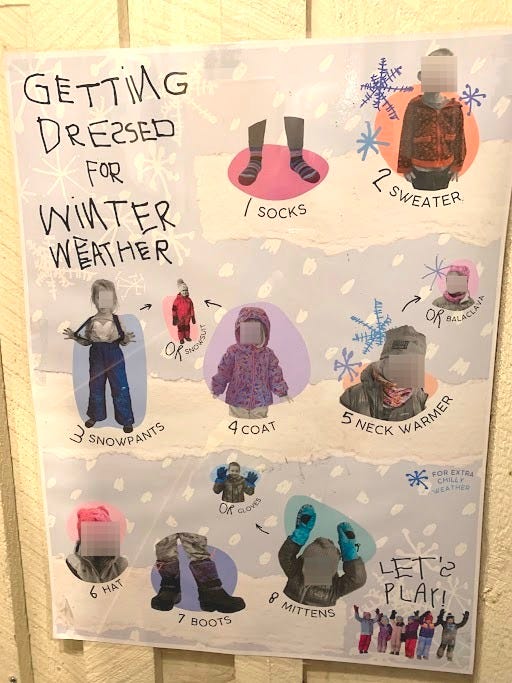
2. Incorporate visual reminders:
Teachers from Spring Hill School used interactive writing to create a step-by-step poster with pictures of their students.
3. Teach a song to remind children of the steps:
Emily uses a song sung to to the tune of Oh My Darling Clementine to help her children remember what goes first, next, etc.
First your snowpants
Then your snowboots
Then your jacket and your hat.
Put on your mittens and you are ready.
You are ready, just like that!
and here’s one for rain gear:
First your rain pants,
Then your rainboots,
Then your raincoat and your hat.
Zip up your coat and you are ready,
You are ready, just like that!
What other tips or tricks do you have for easing the transitions inside and outside?