

Welcome to March Mathness
(we couldn't help ourselves)

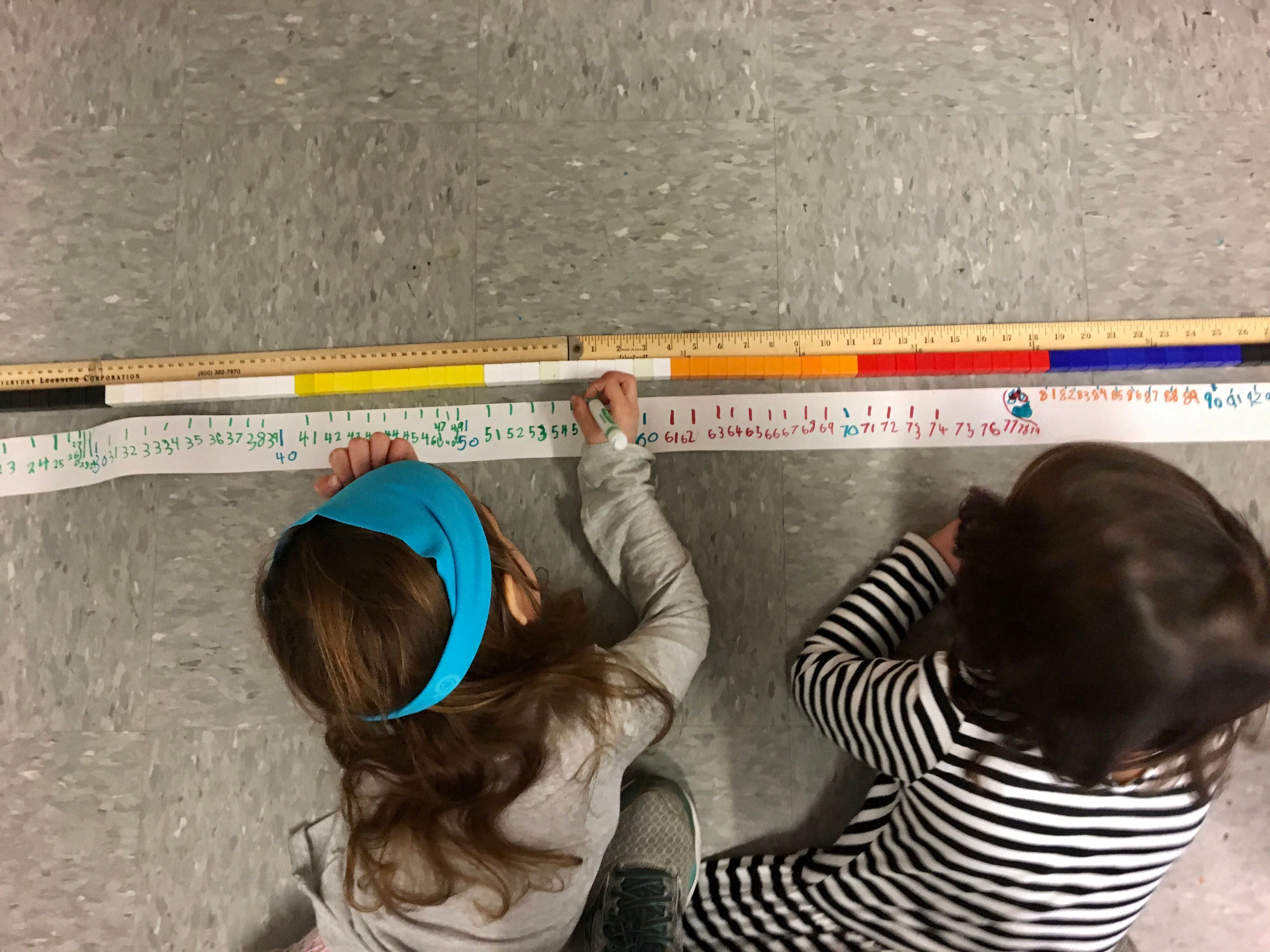
This month we are focusing on math.
We are going to be focused on taking math out of the programs, away from that block in the schedule, off the worksheets, and into the world.
One of the linchpins behind much of our work is this quote from Lilian Katz:
When young children engage in projects in which they conduct investigations of significant objects and events around them, for which they have developed the research questions and by which they themselves find out how things work, what things are made of, what people around them do to contribute to their well-being, and so forth, as can be seen in many reports of project work in the early years, their lively minds are fully engaged. Furthermore, the usefulness and importance of being able to read, write, measure and count gradually becomes self-evident. Lillian Katz “Lively Minds”
So this month, we’ll challenge ourselves to enliven the mathematical minds of our students. We’ll explore where math lives outside of math time, what components of it are especially fascinating to young children, and we will make visible how it exists in much of their learning and play.
Our guiding question will be this:
How can we make math purposeful?
As always: we’d love to hear from you! Send us your questions, your challenges, your favorite resources, and maybe your basketball predictions because Christine’s bracket is practically already busted.
I've been facilitating many trainings on play and inquiry-based approaches to mathematics in the early years recently. Here are a few resources that I've learned a lot from:
"Rehumanizing Mathematics" and the work of Dr. Rochelle Gutiérrez. This is a wonderful big picture framework centering racial equity and culturally sustaining practice in math educacation. This podcast interview is a great place to start: https://www.abolitionsci.org/home/2018/12/11/rehumanizing-math-and-science-with-dr-rochelle-gutierrez
For inspiring and thought-provoking everyday examples of amazing inquiry-based mathematics practice in the early years, (recently retired!) Janice Novakowksi and colleagues at B.C. Reggio-Inspired Mathematics are super rad. Here's her link tree: https://linktr.ee/JaniceNovakowski?utm_source=ig&utm_medium=social&utm_content=link_in_bio
And then Christine Chaille's book "Integrating Math and Science in Early Childhood Classrooms Through Big Ideas" is an awesome place to start for constructivist math education in the early years.